For international buyers researching the Dominican Republic, the two destinations that come up most often are Casa de Campo and Cap Cana. They are the two most established, gated, foreign-buyer-oriented residential resorts in the country. They are also genuinely different products. Choosing between them is the most consequential decision many buyers make about where to spend the next decade of their family’s Caribbean life.
This is an honest comparison written by a buyer’s brokerage with a long history in Casa de Campo. We’re not neutral, and we’ll say so. But the goal here is to lay out the trade-offs so you can decide whether the destination that fits your situation is Casa de Campo, Cap Cana, or neither.
Location and Accessibility
Casa de Campo sits on the southeast coast of the Dominican Republic, between La Romana and the Chavón River. It is a 10-minute drive from La Romana International Airport (LRM), the resort’s de facto private airport — small, fast, and used heavily by direct private jets and a handful of commercial flights. It is 50 minutes from Punta Cana International Airport (PUJ) and 75 minutes from Santo Domingo (SDQ).
Cap Cana is on the eastern tip of the Dominican Republic, immediately adjacent to Punta Cana International Airport (PUJ) — a 10-minute drive from the airport’s main terminal. It is more than two hours from La Romana and over four hours from Santo Domingo.
Practical impact: PUJ is the larger commercial airport with more direct international flights — particularly from the U.S., Canada, and Europe. LRM has fewer commercial flights but is faster, less crowded, and built around private aviation. For owners who fly commercial year-round, PUJ proximity favors Cap Cana. For owners who fly private or who fly commercial via Santo Domingo or Punta Cana with a short drive, LRM works better and Casa de Campo wins on the airport experience.
Maturity and Track Record
Casa de Campo has been operating since 1974. It has the longest track record of any luxury residential resort in the Dominican Republic — 50+ years of homeowners, three governments, multiple economic cycles, multiple hurricanes, and proven infrastructure that has been built and rebuilt over five decades.
Cap Cana broke ground in the early 2000s. Major development accelerated in the 2010s. It is a generation younger than Casa de Campo as a residential community. Its infrastructure is newer (which has advantages) but its operational track record is shorter (which has trade-offs).
Practical impact: Casa de Campo’s resale market is deep and well-documented. You can model returns on decades of actual transactions. Cap Cana’s resale market is real and growing but less mature — pricing histories are shorter, and the future trajectory is more dependent on continued development of the project.
Beach Access and Coastal Character
Cap Cana has the most dramatic beach offering of any DR private community: long stretches of white-sand beach with the broad, shallow, gentle water of the Punta Cana coast. Beachfront residential inventory is meaningful. If your priority is “wake up, walk 100 feet, be in the Caribbean,” Cap Cana is the stronger answer.
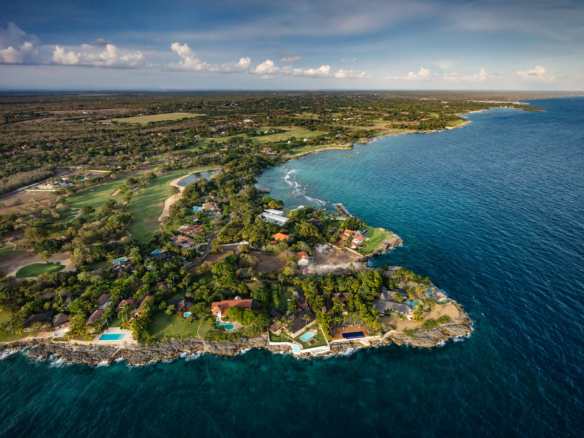
Casa de Campo is built around Minitas Beach — a single, beautifully maintained, family-oriented beach served by the resort’s beach club. There is limited true beachfront residential inventory inside Casa de Campo; most properties marketed as “ocean view” are not directly on sand. The coastline along Punta Aguila has ocean access, but it is rocky coral rather than white sand. The Dominican southeast coast is generally more rugged than the eastern Punta Cana coast.
Practical impact: For buyers prioritizing beach-front living as the defining feature of the home, Cap Cana has structurally more product. For buyers who want a beach club they can walk or golf-cart to and don’t require beach-front access from the residence itself, Casa de Campo works well.
Golf
Casa de Campo has three Pete Dye-designed courses, anchored by Teeth of the Dog — consistently ranked the top course in the Caribbean and one of the top courses in the world. Dye Fore and The Links round out the offering. Owners receive privileged access through the Homeowner Privileges Program.
Cap Cana has Punta Espada, a Jack Nicklaus Signature course also ranked among the best in the Caribbean. Other courses are in various stages of development. Punta Espada is a strong course — but Teeth of the Dog has 50 years of reputation that no new course can replicate.
Practical impact: If golf is central to why you’d own here, Casa de Campo has the deeper offering. If you want one signature course and a newer course experience, Cap Cana works.
Marina and Yachting
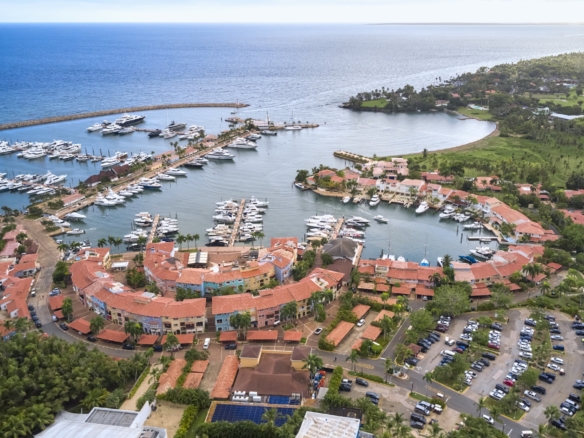
Casa de Campo Marina is a 370-slip deepwater marina opened in 2002, with strong restaurant cluster (La Casita, Causa, SBG, Le Spot, Peperoni), full-service yacht handling, and an active sport-fishing community. It is one of the most established marinas in the Caribbean.
Cap Cana Marina is the newer of the two but has grown rapidly. It can accommodate larger superyachts than Casa de Campo, and its proximity to PUJ makes it convenient for international yacht owners.
Practical impact: Both serious marinas. For boats up to ~200 ft, both work. For 200-300 ft superyachts, Cap Cana has the edge. For dining and social atmosphere around the marina, Casa de Campo’s marina is more mature.
Price Points and Inventory
This is the comparison that matters most to many buyers, and it’s also the one that changes most frequently — so we will speak in general terms.
Casa de Campo has the higher price floor and the higher established price ceiling. Resale villa inventory in established neighborhoods (Punta Aguila, Punta Minitas, Vista Chavón) trades at premium pricing reflecting 50 years of demand and limited supply. Buildable lot inventory is increasingly scarce, particularly in the prime southern neighborhoods.
Cap Cana has lower entry points and more contemporary inventory, particularly in newer condo and villa projects. The market has appreciated rapidly over the past decade, narrowing the historical gap with Casa de Campo. CONFOTUR-eligible inventory is more common in Cap Cana.
Practical impact: If your budget is at the very top of the Caribbean luxury market, both resorts work and Casa de Campo’s deeper pedigree often wins. If you’re entering at the middle of the luxury market, Cap Cana frequently offers more new-construction options at similar or lower price points. CONFOTUR availability also tilts toward Cap Cana.
Rental Market and Investment Returns
Cap Cana has higher rental volume — driven by PUJ proximity, beachfront concentration, and the larger flow of Caribbean vacation traffic to the eastern coast. Net rental yields can be slightly higher, particularly for beachfront condo product.
Casa de Campo has more moderate volume but higher average rates per booking, particularly for high-end villa inventory. Owner-occupancy is higher; pure-investment owners are a smaller share of the market.
Practical impact: For pure cash-flow-focused investors, Cap Cana often produces slightly stronger yields. For owners who use the property and rent secondarily, Casa de Campo offers a more residential community feel and stronger long-hold value.
Lifestyle and Cultural Anchors
Casa de Campo has Altos de Chavón — a 16th-century-style Mediterranean village built on the cliffs above the Chavón River, with an amphitheater that has hosted Sinatra, Santana, Bocelli, and the major touring acts of the past 40 years; an affiliated Parsons design school; restaurants; and a working community of artists. It is a genuine cultural anchor that no other Caribbean resort has.
Cap Cana has the Sanctuary and several smaller plazas with restaurants and shopping, but no equivalent of Altos de Chavón. Cap Cana’s cultural offering is newer and lighter.
Practical impact: For buyers who want their resort to have a cultural texture — concerts, galleries, working artists, an actual place to walk through that feels like a town — Casa de Campo has no comparable answer in the DR. For buyers whose priority is beach, golf, and good food without a cultural anchor, Cap Cana works equally well.
Security and Operations
Both resorts are gated, with 24/7 perimeter security, controlled access, and well-managed internal infrastructure. We have not seen meaningful differences in security between the two in normal operations.
Both maintain their own road networks, water and power infrastructure, and waste management.
Who Casa de Campo Fits Best
- Buyers who want a long track record and a deep resale market
- Golfers who prioritize the Teeth of the Dog level of course
- Buyers who value cultural texture (Altos de Chavón, the marina, the breadth of food and activity)
- Owners closer to private aviation or comfortable connecting through Punta Cana
- Long-hold owners more focused on appreciation than cash flow
Who Cap Cana Fits Best
- Buyers prioritizing white-sand beachfront living as the primary feature
- Owners who fly commercial year-round into PUJ
- Buyers attracted to newer construction and contemporary architecture
- Investors focused on rental cash flow over long-hold appreciation
- Buyers actively looking for CONFOTUR-qualified inventory
How Smart Buyers Actually Decide
The buyers we work with who end up most satisfied with their choice typically:
- Visit both for 2–3 days each before making any decision
- Stay in actual rentals in each resort rather than at hotels, to experience day-to-day life
- Eat at the local restaurants, play the local golf, walk the local infrastructure — not just tour properties
- Get specific about how they’ll use the home, then map that against what each resort actually offers
Most buyers who do this come back with strong personal preferences. The decision usually becomes obvious after immersion that wasn’t obvious from photos and reviews.
We can help you build that comparison trip — including property visits in both resorts — through buyer-side relationships in each market. We work exclusively at Casa de Campo, but we can connect you with trusted buyer-side colleagues in Cap Cana if your comparison takes you that direction.
Schedule a consultation or email info@caribbeanparadisehomes.com.
Frequently Asked Questions
Is Casa de Campo or Cap Cana more expensive?
In general, Casa de Campo has a higher price floor and the historical premium for established luxury inventory. Cap Cana’s prices have grown rapidly and narrowed the gap. At the very top of the market both resorts offer ultra-luxury inventory at similar pricing; in the mid-tier, Cap Cana frequently has lower entry points.
Which has better golf?
Casa de Campo has more depth (three Pete Dye courses, including Teeth of the Dog), and Teeth of the Dog has a level of reputation that takes generations to build. Cap Cana’s Punta Espada is genuinely strong. For golf-driven buyers, Casa de Campo is the stronger fit.
Which has better beaches?
Cap Cana, structurally. The eastern Dominican coast has long white-sand beaches with calmer water; the southeastern coast where Casa de Campo sits is rockier with Minitas Beach as the central swimming destination. If beachfront living is your priority, Cap Cana wins.
Can I rent a property to test the resort before buying?
Yes. Both resorts have active vacation rental markets. We strongly recommend renting in any resort you’re considering before making a purchase decision. A week in each, ideally during high season, will tell you more than any brochure.
Are rental yields better in Cap Cana?
In general, yes — slightly. Cap Cana has higher rental volume driven by airport proximity and beachfront concentration. The trade-off is more competition and a more transient owner base. Casa de Campo yields are slightly lower but more stable, with higher owner occupancy.
Does CONFOTUR availability favor one over the other?
In general, more CONFOTUR-qualifying new-construction inventory is available in Cap Cana than in Casa de Campo, where most resale villas in established neighborhoods are not CONFOTUR-eligible. Always verify project-specific status with your attorney.
Caribbean Paradise Homes is a licensed real estate brokerage based at Casa de Campo. We exclusively represent buyers and can introduce you to trusted buyer-side colleagues in Cap Cana if your comparison takes you that direction. For a consultation, contact us at info@caribbeanparadisehomes.com.